Choosing a reliable custom eyeshadow palette manufacturer in China requires more than comparing colorful product photos. Behind each palette are pigment performance, pressed-powder stability, packaging accuracy, sampling discipline, and communication speed. A beautiful prototype may still fail during mass production. That matters.
Maggie Lee, a senior color-cosmetics product development consultant, explains: “A successful palette balances creative color with repeatable manufacturing.” This principle guides the selection in this article. The featured companies are evaluated through practical criteria, including formulation capability, minimum order quantities, private-label support, packaging options, quality-control procedures, export experience, and responsiveness during development. These details can affect whether a palette arrives with clean pans, consistent shades, and a durable magnetic closure.
Details matter most.
A dependable custom eyeshadow palette manufacturer should provide clear ingredient documentation, realistic production timelines, and samples that represent finished production quality. Buyers should also confirm applicable cosmetic safety requirements in their target markets, because compliance expectations vary by region. Certifications may support credibility, but they should be verified rather than accepted at face value.
No ranking is perfect. Supplier capabilities can change, and a manufacturer suitable for a boutique launch may not support large retail volumes. Some companies communicate quickly but offer limited formulation flexibility. Others provide advanced packaging while requiring higher minimum orders. This overview acknowledges those trade-offs and focuses on evidence that buyers can examine before signing a manufacturing agreement. The goal is not to promise a flawless partner, but to make supplier evaluation more practical, transparent, and informed.
How Custom Eyeshadow Palette Manufacturing Works in China
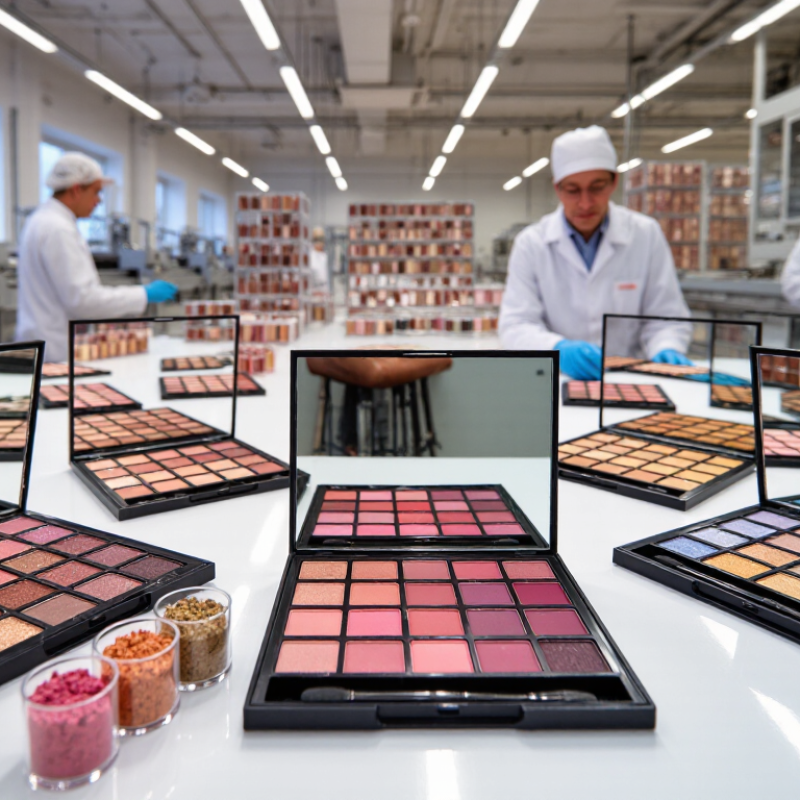
Custom eyeshadow palette manufacturing in China begins with a clear product brief. Buyers define the palette size, shade count, finish, pigment level, pan shape, and packaging materials. A reliable manufacturer then checks whether the design is practical for tooling and production. This step can prevent uneven pans and weak hinges later. The color team usually prepares laboratory samples before full-size prototypes. Each shade is tested for blendability, payoff, fallout, and stability. However, digital color references are not perfectly accurate. A physical sample remains essential.
Tips: Request several sample rounds. Check the palette under daylight, office light, and camera lighting. Ask for written specifications, batch records, and ingredient documentation. Confirm minimum order quantities and production timelines before approving the formula.
After approval, the factory produces pressed powder in controlled batches. Operators monitor filling weight, pressing pressure, surface texture, and shade consistency. Quality teams inspect pans, mirrors, closures, labels, and printed cartons. Stability checks can reveal cracking, oil separation, or color changes during storage. Packaging compatibility also matters, especially when powders contact foam or adhesive. From practical sourcing experience, small details often create costly delays. A missing color code or unclear artwork can stop production. Pre-shipment inspection helps, but it cannot replace careful communication throughout development. Manufacturers with documented procedures, trained technicians, and traceable quality records offer stronger support for custom palette projects.
Key Criteria for Evaluating Chinese Palette Manufacturers
For a Top 10 custom eyeshadow palette list, price should not lead the evaluation. A practical factory audit should test pigment uniformity, pan adhesion, powder fallout, and shade repeatability. These details influence reviews and repeat orders. Grand View Research valued the global color cosmetics market at about US$70.4 billion in 2023. Consistency is not optional.
Quality evidence matters more than polished presentations. Request batch records, raw-material specifications, stability data, and retained samples. ISO 22716 certification helps, but it does not prove every production run is controlled. Review corrective-action records and inspect the filling line. A perfect sample can still mislead.
Commercial reliability needs equal attention. Compare minimum order quantities, mold ownership, lead times, packaging tolerances, and replacement policies. McKinsey’s 2023 beauty-market analysis projected the global beauty sector could reach roughly US$580 billion by 2027, with annual growth near 6%. A manufacturer must therefore scale without changing texture or color. Ask for three production samples, not one. That costs more. It exposes weaknesses earlier. Some evaluations still overlook artwork approval delays and carton compression during shipping. That is a practical gap worth challenging.
Profiles of the Top 10 Custom Eyeshadow Palette Manufacturers
The ten profiles examine how Chinese manufacturers develop custom eyeshadow palettes from concept to finished packaging. Each profile considers formulation experience, color development, pressing methods, and production consistency. Several manufacturers support small and medium production runs. Others focus on larger orders and automated filling lines. Their facilities may include pigment rooms, pressing areas, and controlled packaging stations.
A reliable manufacturer should provide ingredient documentation, stability information, and clearly labeled samples. The profiles compare matte, shimmer, metallic, and cream-powder textures. They also review pan size, palette layout, magnetic inserts, and surface finishing. Some teams offer prototype revisions after wear testing. This matters when shadows crease, fade, or produce excessive fallout. Practical testing reveals more than a polished presentation.
Details can expose meaningful differences. One supplier may deliver vivid color but struggle with matching small batches. Another may produce excellent packaging but require longer sampling periods. That is not automatically a failure. It needs careful review. Buyers should check quality systems, batch records, worker training, and export documentation before placing orders. Manufacturing claims should be verified through samples and independent testing where appropriate. These profiles therefore focus on evidence, communication, and repeatable results, not attractive promises alone. Certain factories appear highly capable, yet their limitations deserve equal attention.
Top 10 Custom Eyeshadow Palette Manufacturers in China
Profile Comparison of Common Manufacturing Capabilities
This chart compares the most frequently highlighted capabilities in public profiles of leading Chinese custom eyeshadow palette manufacturers. OEM/ODM production, custom packaging, shade development, sampling, compliance support, and flexible minimum order quantities are key factors for evaluating a potential manufacturing partner.
Comparing Products, Minimum Orders, Pricing, and Production Capabilities
Top 10 Custom Eyeshadow Palette Manufacturers in China
China’s ten leading custom eyeshadow manufacturers differ sharply in product quality, minimum orders, pricing, and production capacity. Their catalogues may include pressed powder, cream, liquid, and refillable palettes. Small workshops often accept 500–1,000 units, while audited factories usually request 3,000–10,000 units. Indicative prices range from US$1.20 to US$6.50 per palette, depending on shade count, packaging, pigments, and decoration. Grand View Research valued the global color cosmetics market at about US$70 billion in 2023. That demand encourages faster sampling, but speed can hide weak testing systems.
Production capability matters more than a polished catalogue. Larger facilities may operate automated filling lines, in-house laboratories, stability testing, and monthly capacities above 100,000 units. Smaller manufacturers can offer better flexibility and unusual packaging, yet their batch consistency may vary. Ask for recent batch records, ingredient specifications, microbial testing, and production photographs. ISO 22716-based quality systems are useful evidence, but certification alone does not prove every batch is reliable. I would also compare sample performance after four weeks, not only on the first day. My own caution: supplier websites often present capacity figures without independent verification.
Tips: Request three quotes with identical specifications. Separate formula, packaging, testing, and freight costs. Confirm whether the MOQ applies per palette, shade, or total order. The OECD notes that supply-chain due diligence reduces avoidable quality and sourcing risks. A written approval sample can prevent expensive colour and printing disputes.
How to Select and Partner With the Right Manufacturer
Top 10 Custom Eyeshadow Palette Manufacturers in China
How to Select and Partner With the Right Manufacturer
China’s custom eyeshadow sector serves a growing global beauty market. McKinsey’s 2023 Future of Beauty report expects the market to reach about $580 billion by 2027. This growth creates more supplier choices, but also more noise. A polished website proves very little.
Evaluate each manufacturer through samples, documentation, and factory communication. Ask for pigment consistency, pressed-pan weight, fallout results, and packaging tolerances. Request batch records, stability testing, ingredient specifications, and ISO 22716 Good Manufacturing Practice evidence. Confirm whether the factory manages formulation, pressing, filling, printing, and final inspection internally. Outsourcing can increase delays and quality gaps.
Small details matter.
For export projects, review compliance support for your target market. Check ingredient restrictions, labeling rules, safety files, and responsible-person requirements before approving artwork. A reliable partner should explain these requirements clearly, not promise universal compliance. The European Commission’s cosmetics framework and U.S. regulatory guidance both require careful product documentation, although obligations differ by market.
Use a staged partnership. Approve laboratory samples first, then a pilot order, then larger production. Define color tolerances, defect limits, delivery terms, corrective actions, and ownership of custom formulas in writing. Grand View Research valued the global cosmetics market at approximately $446.2 billion in 2023, with continued growth projected through 2030. Yet rapid demand can pressure factories to overpromise capacity. I would treat unusually low quotations carefully. They may exclude testing, tooling, or realistic lead times. A factory can look excellent and still need stronger controls. That is worth discovering early.
FAQS
Specify palette size, shade count, finishes, pigment level, pan shape, and packaging materials. Include artwork files and color references. Clear details reduce tooling mistakes and production delays.
Digital colors can shift between screens, printers, and lighting conditions. Check physical samples under daylight, office light, and camera lighting. Digital approval alone is risky.
Request several rounds when shades, texture, or packaging need adjustment. Test blendability, payoff, fallout, and surface appearance. One sample may look perfect but still reveal problems later.
Inspect filling weight, pressing pressure, surface texture, and shade consistency. Uneven pan levels can affect appearance and user experience. Small defects become expensive after mass production.
Request ingredient specifications, batch records, stability results, and written product specifications. Also request quality procedures and safety documentation. Missing paperwork can delay market approval.
Review samples, factory communication, documentation, and production records. Ask whether formulation, pressing, filling, printing, and inspection happen internally. A polished website proves very little.
Define color tolerances, defect limits, delivery terms, corrective actions, and formula ownership. Confirm minimum order quantities and realistic lead times. Verbal promises are easy to misunderstand.
Approve laboratory samples, then a pilot order, before larger production. This exposes capacity, packaging, and consistency problems early. It is slower, but often cheaper.
Powders may react poorly with foam, adhesives, mirrors, or closures. Check for cracking, oil separation, color changes, and weak hinges during stability testing. Packaging is not merely decoration.
Ask whether testing, tooling, inspection, and realistic delivery times are included. Very low prices may hide missing services or weaker controls. I would investigate carefully.
Conclusion
This guide provides a practical overview of the top 10 custom eyeshadow palette manufacturers in China and explains how custom palette production typically works, from concept development and shade selection to packaging design, sampling, quality inspection, and final delivery. It also outlines the key criteria buyers should consider when evaluating a custom eyeshadow palette manufacturer, including formulation capabilities, color consistency, ingredient transparency, manufacturing standards, communication, lead times, and production flexibility.
The article compares the featured manufacturers by product range, minimum order quantities, pricing structure, customization options, and production capacity. It also discusses how to select a suitable partner based on your target market, budget, design requirements, order volume, and expected growth. By understanding each stage of the manufacturing process and asking the right questions before placing an order, buyers can reduce risks, improve product quality, and build a more efficient, reliable, and long-term manufacturing partnership.